



A British company paid $271million by the state of California to build a mental health app for troubled teenagers is being sued in the High Court over claims it ripped off a small charity’s idea.
Kooth PLC, listed on London’s AIM market, is facing an intellectual property claim brought by Hidden Strength Holdings, a firm linked to The Hidden Strength Foundation, a Windsor-based youth mental health charity.
The claim, filed in April, concerns the development of Soluna, the free app Kooth built under a $271million California state contract. The charity claims Kooth stole its designs for the app, handed over under a non-disclosure agreement just nine days before the deal was signed.
The US business now accounts for approximately 70 per cent of Kooth’s revenue in the first half of this year. Kooth also supplies digital mental health services across the UK’s National Health Service, and this autumn it launched Soluna in the UK.
In June 2026, Kooth’s communications official told this reporter that the company’s litigation would be concluded within weeks.
But nearly six months later, the lawsuit continues against Kooth. The judge allowed the key allegations set out in the claim to proceed, fully rejecting only a minor claim concerning the app’s colour scheme.

The charity had, the judge said, properly pleaded that a six-minute demonstration video and a meeting in August 2023 disclosed new and confidential features that were not in the public domain, and whether those features ended up in Soluna was a question for a trial.
The lawsuit alleges breach of the non-disclosure agreement and misuse of confidential information. The charity is seeking damages, or alternatively an account of Kooth’s profits, and says it lost prospective partnerships with Sky and Vodafone’s youth brand VOXI and had its planned expansion into America “foreclosed” by the launch of Soluna.
The revelations of the lawsuit, which would invalidate Kooth’s main source of revenue, come as the company is seeking to renew the California contract next summer.
Kooth’s work with the California state came under public scrutiny in 2024 after it emerged that Kooth improperly financed the state’s mental health oversight chief, Toby Ewing, and his fellow officials’ travel to London at a time when he had been pressing legislators to protect Kooth’s contract.
Ewing was forced to resign over the inappropriate relationship with the company, but no public action was taken against Kooth for its involvement. Ewing did not respond to repeated requests for an interview.
But emails released under California’s public records law, and not previously reported, show that Kooth actively cultivated the relationship with Ewing to maintain the contract with the state of California, raising fresh concerns of undisclosed lobbying by a state official on behalf of a state contractor.
On June 27, 2024, the morning after a Kooth-hosted “knowledge exchange” event in London, which Ewing attended during his Kooth-funded trip to England, he emailed Kate Newhouse, then Kooth’s chief operating officer and now its chief executive, a strategy paper he had already shared with California Senate staff two weeks earlier, setting out his ideas for the state’s digital mental health provision.
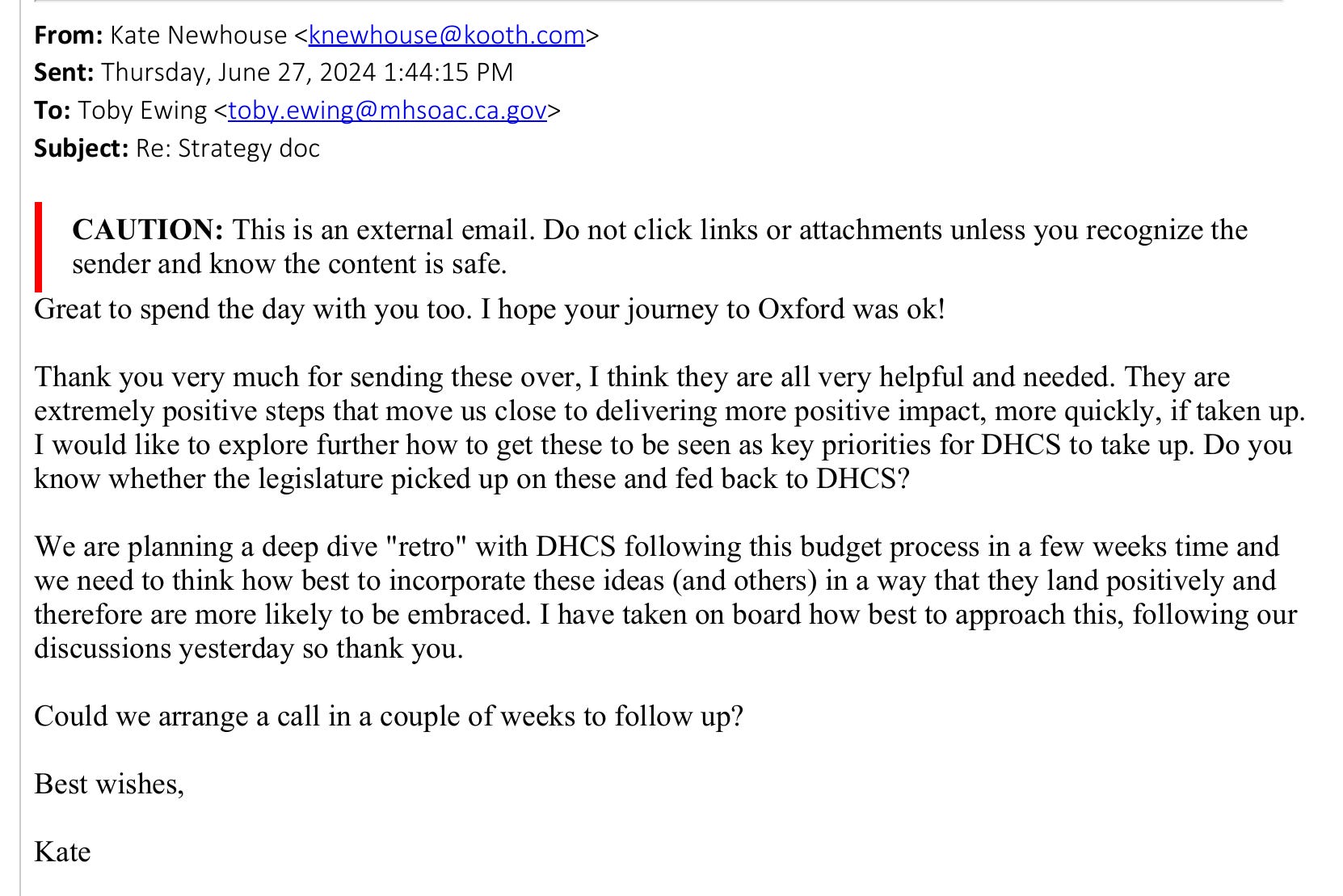
Newhouse replied within hours, thanking him for the “very helpful and needed” ideas, and asked: “Do you know whether the legislature picked up on these and fed back to DHCS? [California Department of Health Care Services]” She told him Kooth was planning a “deep dive” review with the health department after the budget round, to work out how “to incorporate these ideas (and others) in a way that they land positively and therefore are more likely to be embraced.”
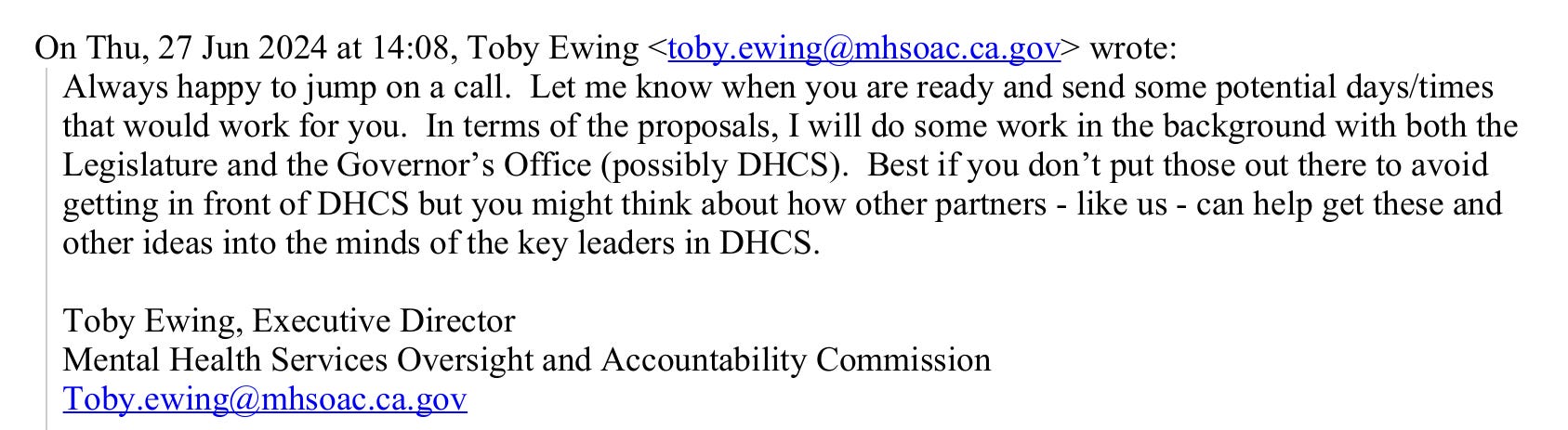
Ewing replied that he will “do some work in the background with both the Legislature and the Governor’s Office (possibly DHCS)” on Kooth’s proposals, and advises her: “Best if you don’t put those out there”, to avoid “getting in front of DHCS”, the department that holds the $271million contract.
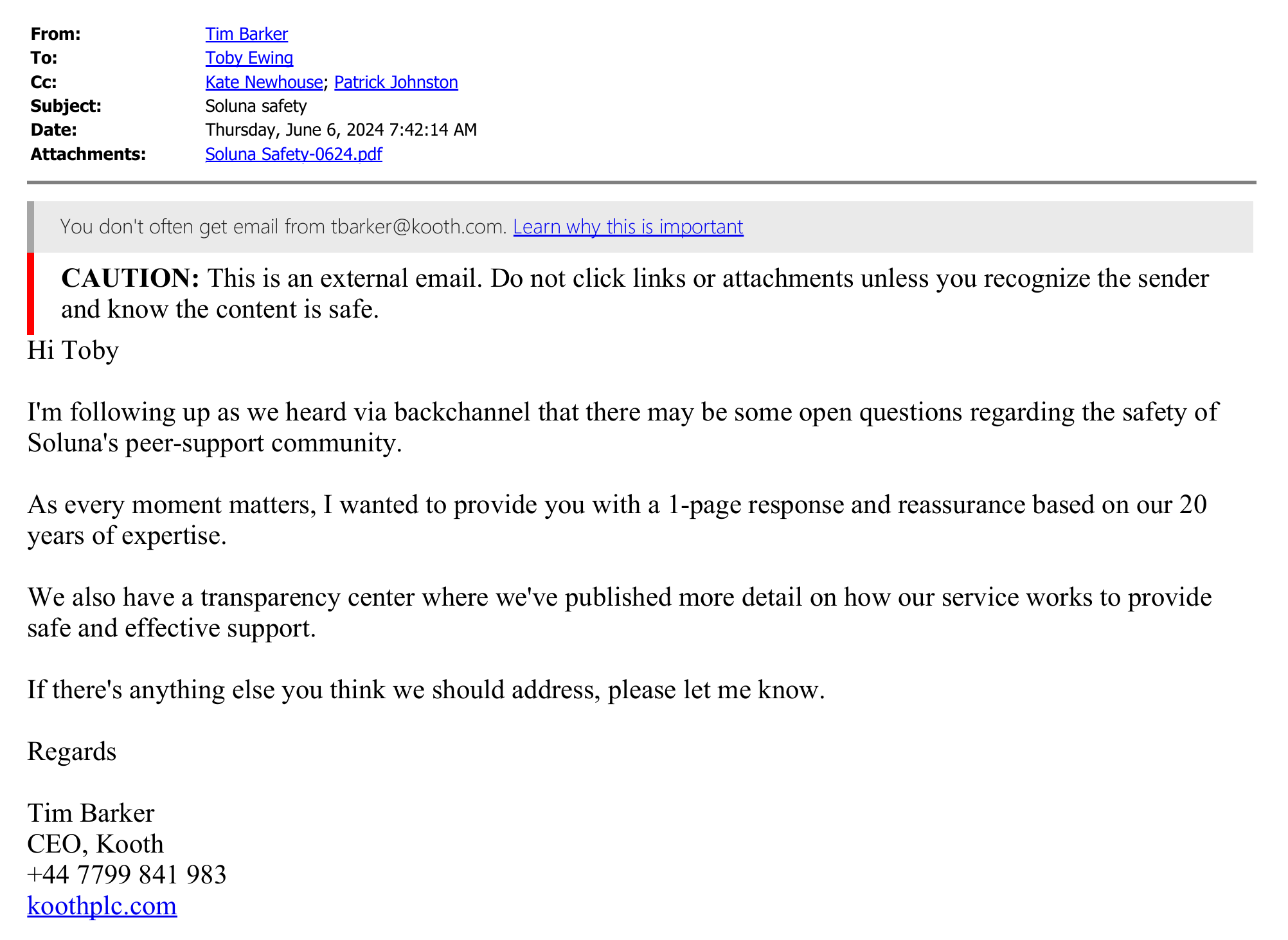
In another email, dated that same month, Tim Barker, then Kooth’s chief executive, writes to Ewing, copying in Newhouse: “I’m following up as we heard via backchannel that there may be some open questions regarding the safety of Soluna’s peer-support community.” He also attached a one-page reassurance document.
The correspondence runs through the summer as Kooth’s leadership arranged meetings with state officials around a visit to Sacramento.
The lawsuit brought forward by the charity sets out how, in the space of just ten days in June 2023, Kooth went from quizzing the charity about its app to signing a $271million California contract.
In June 2023, Linsey Lunny, the foundation’s founder and chief executive, met Sanjay Jawa, Kooth’s finance chief. The claim states that Jawa quizzed her about the charity’s app, including how it worked, how long it had taken to build, how it was funded and how it made money. At no point, the claim says, did he mention that Kooth was building an app of its own.
Within a day, he had signed a non-disclosure agreement. The same day, the charity sent over its pitch deck and the six-minute video walkthrough of the app. Nine days later, Kooth signed the $271million California contract.
Nine weeks after that, Kooth delivered Soluna to California’s health department. The claim notes that Kooth’s own developer, the design firm IDEO, worked to a nine-week build timeline, a window that opens only after the charity’s material arrived.
Soluna, the charity claims, was its app in all but name. For example, therapy sessions were presented in the style of TikTok and Instagram feeds, just as the charity had designed them. Soluna offered drop-in chats and booked coaching sessions, mirroring the charity’s “Chat to us now” and booked therapy functions.
Crucially, according to court documents, Soluna also contains a live-streamed events feature that mirrors a function the charity had built but never made public, which was only disclosed in the confidential six-minute demo video provided to Kooth under the NDA.
The claim also alleges that when Lunny asked Newhouse, then Kooth’s chief operating officer and now its chief executive, whether the company’s American product was an app, she was told it was a website.
Weeks after Soluna was delivered to California, Newhouse cancelled the charity’s next meeting by email, praising the “great product” it had developed but saying Kooth had no “bandwidth” for collaboration.
Kooth and its leadership have repeatedly been approached for a comment. Kooth cancelled a scheduled call after it was provided with a list of key points of the article.